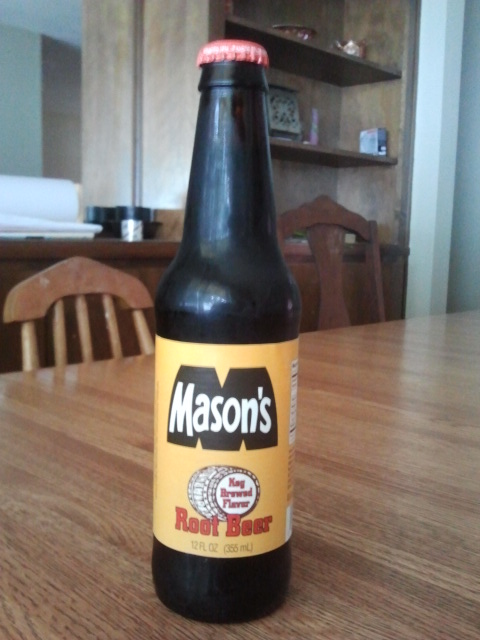
My wife was recently on a grocery excursion when this particular bottle of root beer caught her eye, so she purchased aforementioned beverage and brought it home to me.
On the bottle, Mason's proclaims they have a "Keg Brewed Flavor"-which might be true. It is a good root beer, very root beer-esque, if you will, but it seems the keg it was brewed in was mostly already filled with Hires anyways, so they just put that in their own bottle and called it a day.
I don't really think I need to say anything else.
Packaging- 4/5
Ummm...it caught my wife's eye for some reason-yellow label and kegs maybe? I like the vintage look of the non-color Kegs and the basic brown/red on yellow.
Aroma- 4/5
Smells like Hires.
Taste- 5/7
Tastes exactly like Hires. Fake sassafras, a little wintergreen and a smidge of vanilla for creaminess. There's nothing wrong with tasting like Hires, it's one of the best and oldest out there. Nearly every company has made a Hires clone, so it's not really a wonder I stumbled across yet another one. If you've never had Hires and aren't exactly sure what it tastes like, go to the store and buy a bottle of root beer extract-nearly every brand is just a Hires clone. Root beer barrels are also Hires-flavored, even the A&W brand.
Overall- 13/17
It'd rate higher if it were Hire's, but incidentally it's not.
Showing posts with label vanilla. Show all posts
Thursday, June 21, 2012
Wednesday, June 20, 2012
Recipe: Homemade Virgil's Root Beer Clone From Scratch
I'm going to start off by saying this-I'm quite aware that Virgil's lists the spices they use to flavor the root beer on the packaging, however, they do not list amounts. I decided to give it a try, excluding those spices I find either undesirable(cloves), or those things which I did not have in my ingredients vault(birch of any kind).
I combined all of the below together, and came up with a very close approximation of a tasty bottle of Virgil's.
1 tbsp. Licorice Root
4 crushed Star Anise Pods
1 Cinnamon stick(approx. 4 inches)
1 Vanilla Bean(approx. 6 inches)
1tbsp. dried Wintergreen Leaves
1/4 tsp. ground Nutmeg
5 pieces of whole Allspice
2 cups of Cane Sugar
2 tbsp. Blackstrap Molasses
1/8 tsp. yeast
4.5 qts. of Water
Start off filling your stockpot with 4.5 quarts of water, place all ingredients(minus sugar + yeast) into pot, turn to med-hi heat and bring to a boil. Reduce heat to medium-low and allow to simmer with the lid on for approximately 20-30 minutes. Stir in your 2 cups of sugar and molasses, place in ice-water bath to allow to cool.
When the mixture gets down to about 95 degrees Fahrenheit, scoop a little bit into a coffee cup and add yeast to the coffee cup. After allowing yeast to culture for about 5 minutes, dump contents of coffee cup back into pot and stir in well. Bottle and wait 3-4 days(dependent on temperature), then move bottles to the fridge. You'll have a nice, homemade version of Virgil's Root Beer waiting for you. I'd say your best flavor comes about 3 days after placing it in the fridge. The amount of molasses can be modified to taste.
Try it for yourself and let me know in the comments how much/little you think it tastes like Virgil's.
I combined all of the below together, and came up with a very close approximation of a tasty bottle of Virgil's.
1 tbsp. Licorice Root
4 crushed Star Anise Pods
1 Cinnamon stick(approx. 4 inches)
1 Vanilla Bean(approx. 6 inches)
1tbsp. dried Wintergreen Leaves
1/4 tsp. ground Nutmeg
5 pieces of whole Allspice
2 cups of Cane Sugar
2 tbsp. Blackstrap Molasses
1/8 tsp. yeast
4.5 qts. of Water
Start off filling your stockpot with 4.5 quarts of water, place all ingredients(minus sugar + yeast) into pot, turn to med-hi heat and bring to a boil. Reduce heat to medium-low and allow to simmer with the lid on for approximately 20-30 minutes. Stir in your 2 cups of sugar and molasses, place in ice-water bath to allow to cool.
When the mixture gets down to about 95 degrees Fahrenheit, scoop a little bit into a coffee cup and add yeast to the coffee cup. After allowing yeast to culture for about 5 minutes, dump contents of coffee cup back into pot and stir in well. Bottle and wait 3-4 days(dependent on temperature), then move bottles to the fridge. You'll have a nice, homemade version of Virgil's Root Beer waiting for you. I'd say your best flavor comes about 3 days after placing it in the fridge. The amount of molasses can be modified to taste.
Try it for yourself and let me know in the comments how much/little you think it tastes like Virgil's.
Wednesday, August 24, 2011
Recipe: Homemade Cream Soda from Scratch -Batch 2
My wife recently requested I make her a soda that she'd actually like. Knowing that she loves cream soda, I made a batch-and it turned out tasting really good. The last batch I made was too much cinnamon, and ended up with a weird off-taste that most batches with cinnamon tend to develop.
I excluded the cinnamon from this recipe and added something else for a little bit of complexity beyond the vanilla alone.
2x 6 inch vanilla beans(cut into many pieces with kitchen shears)
1 pinch of raisins(about 6)-each cut in half by kitchen scissors
1 pinch of dried cranberries(about 6)-each cut in half by kitchen scissors
1 tbsp. honey
2 cups sugar
1 gallon of water
1 dash of ale yeast
Fill a stock pot with 2 quarts of water, place vanilla beans, raisins and dried cranberries into the stock pot. Bring to a simmer on medium-high heat. Let simmer 20 minutes, stirring on occasion.
Add 1 quart of cold water to the brew, letting steep about 10 minutes.
Stir in 1 tbsp of honey, add last quart of water and remove from heat. Let steep another 15 minutes. While steeping for 15 minutes, get your bottles and caps ready. Fill sink with cold water and ice. Not too full, as you'll be placing your stockpot in there to cool the brew.
After the brew has cooled to about 90 degrees Fahrenheit, scoop some into a coffee cup and add the yeast.
Strain the brew into your bottling bucket(or another stock pot). Stir in your yeast and bottle!
I got about ten 12 oz. bottles.
The sample taste I tried before bottling reminded me alot of Thomas Kemper's. It was double-vanilla strength with slight fruitiness. It had a beautiful golden-yellow color-much like honey or ginger ale.
I excluded the cinnamon from this recipe and added something else for a little bit of complexity beyond the vanilla alone.
2x 6 inch vanilla beans(cut into many pieces with kitchen shears)
1 pinch of raisins(about 6)-each cut in half by kitchen scissors
1 pinch of dried cranberries(about 6)-each cut in half by kitchen scissors
1 tbsp. honey
2 cups sugar
1 gallon of water
1 dash of ale yeast
Fill a stock pot with 2 quarts of water, place vanilla beans, raisins and dried cranberries into the stock pot. Bring to a simmer on medium-high heat. Let simmer 20 minutes, stirring on occasion.
Add 1 quart of cold water to the brew, letting steep about 10 minutes.
Stir in 1 tbsp of honey, add last quart of water and remove from heat. Let steep another 15 minutes. While steeping for 15 minutes, get your bottles and caps ready. Fill sink with cold water and ice. Not too full, as you'll be placing your stockpot in there to cool the brew.
After the brew has cooled to about 90 degrees Fahrenheit, scoop some into a coffee cup and add the yeast.
Strain the brew into your bottling bucket(or another stock pot). Stir in your yeast and bottle!
I got about ten 12 oz. bottles.
The sample taste I tried before bottling reminded me alot of Thomas Kemper's. It was double-vanilla strength with slight fruitiness. It had a beautiful golden-yellow color-much like honey or ginger ale.
Labels:
ale yeast,
cane sugar,
cream soda,
dried cranberries,
from scratch,
Homemade,
raisins,
recipe,
vanilla
Saturday, August 20, 2011
Homemade Old Fashioned Root Beer from Scratch Follow Up
This has been one of my best brews yet. It carbonated within 24 hours, provided a tasty, refreshing beverage with an excellent head, and it has gone rather quickly.
I will say that the amount of Sassafras is a little excessive-imparted a bit too much of that for the first day of drinking. It's improved with age, but I imagine cutting down the 7 tbsp. to 4 will be more then sufficient. The 7 tbsp. was about 3 oz. I believe, and most "old fashion" recipes only call for an ounce per gallon. Oh well, I wanted a strong sassafras flavor and got it.
In addition to the sassafras, however, I also detect hints of molasses, cinnamon and a slight bit of black licorice. It has a bit of a bite to it-much like Barq's.
Another excellent side effect of this homemade root beer from scratch? The wort left over has made quite the nice potpourri. The mixing cup full of the strained wort still sits in our window sill, and every breeze sends subtle hints of root beer tones floating through our nostrils.
Next up-Sarsaparilla and my attempt to clone an excellent store-bought Root Beer.
Click here for the recipe to this homemade root beer...
I will say that the amount of Sassafras is a little excessive-imparted a bit too much of that for the first day of drinking. It's improved with age, but I imagine cutting down the 7 tbsp. to 4 will be more then sufficient. The 7 tbsp. was about 3 oz. I believe, and most "old fashion" recipes only call for an ounce per gallon. Oh well, I wanted a strong sassafras flavor and got it.
In addition to the sassafras, however, I also detect hints of molasses, cinnamon and a slight bit of black licorice. It has a bit of a bite to it-much like Barq's.
Another excellent side effect of this homemade root beer from scratch? The wort left over has made quite the nice potpourri. The mixing cup full of the strained wort still sits in our window sill, and every breeze sends subtle hints of root beer tones floating through our nostrils.
Next up-Sarsaparilla and my attempt to clone an excellent store-bought Root Beer.
Click here for the recipe to this homemade root beer...
Thursday, August 18, 2011
Recipe: Homemade Old Fashioned Root Beer From Scratch
After one root beer experiment, I decided I needed to try to make an old-fashioned style Root Beer. It doesn't use some of the more traditional ingredients(like burdock, or dandelion root, or hops), but it is made with sassafras for that distinct root beer flavor that everyone associates specifically with root beer.
Here goes.
7 tbsp. Sassafras root(chopped and dried)
1 tbsp. wintergreen leaves
1 tbsp. anise seed(crushed)
1 tsp licorice root
1 3 in. Cinnamon stick
1 6 in. vanilla bean
2 cups of cane sugar
1 cup of brown sugar
1.5 gallons of water
1/4 tsp. ale yeast
Fill a stock pot with 1 gallon of water, and a jar(or bottle) with 1/2 gallon of water. Place the 1/2 gallon of water in the refrigerator, and combine all the herbs and spices above in the stock pot. Bring to a simmer, and after about 25 minutes(10 minutes of getting up to heat, 15 minutes to steep). Stir in both sugars, add cold water from the refrigerator, and let cool to under 100 degrees Fahrenheit.(I allowed mine to go to about 85).
Scoop a cup full of brew into a small container, add 1/4 tsp. of yeast, and allow it to work for 5-10 minutes. Strain the brew into another container(brew bucket), then mix in the yeast water. It's ready to bottle.
It's only been about 24 hours since I've made my brew and it's already carbonated-this could be due to the larger amount of yeast or the warmer weather, but fair caution, this might carb up a little more quickly then the other batches have.
There will be a follow up soon enough.
Here goes.
7 tbsp. Sassafras root(chopped and dried)
1 tbsp. wintergreen leaves
1 tbsp. anise seed(crushed)
1 tsp licorice root
1 3 in. Cinnamon stick
1 6 in. vanilla bean
2 cups of cane sugar
1 cup of brown sugar
1.5 gallons of water
1/4 tsp. ale yeast
Fill a stock pot with 1 gallon of water, and a jar(or bottle) with 1/2 gallon of water. Place the 1/2 gallon of water in the refrigerator, and combine all the herbs and spices above in the stock pot. Bring to a simmer, and after about 25 minutes(10 minutes of getting up to heat, 15 minutes to steep). Stir in both sugars, add cold water from the refrigerator, and let cool to under 100 degrees Fahrenheit.(I allowed mine to go to about 85).
Scoop a cup full of brew into a small container, add 1/4 tsp. of yeast, and allow it to work for 5-10 minutes. Strain the brew into another container(brew bucket), then mix in the yeast water. It's ready to bottle.
It's only been about 24 hours since I've made my brew and it's already carbonated-this could be due to the larger amount of yeast or the warmer weather, but fair caution, this might carb up a little more quickly then the other batches have.
There will be a follow up soon enough.
Labels:
anise,
cinnamon,
Homemade,
licorice root,
old fashion,
recipe,
Root Beer,
sassafras,
vanilla
Recipe: Cardamom Cream Soda
I first tried Cardamom a few years ago in the form of cardamom ice cream, made locally at an ice cream shop in downtown Bellingham, Washington known as "Mallards". It's a rich, aromatic spice that lends itself well to many dishes-meat, stews, sweets and treats. It's also most widely recognized as one of the components in chai tea.
I decided I wanted to try a cardamom-flavored soda, but I think I may have been overly ambitious with the large amount of ingredients. It produced a very good flavor, but I may have let the yeast work a little too long and ended up with a less then sweet, spicy concoction. Flavorful, to be sure, but not at all what it should have been.
20 cardamom seed pods
1/4 cup of raisins(coarsely chopped)
1 6 inch vanilla bean(cut)
1 sliver of nutmeg(probably too much nutmeg)
1 3 inch cinnamon stick
1/4 tsp. cream of tartar
2 cups of brown sugar
1 gallon of water
1/8 tsp. yeast
Combine all ingredients besides the cream of tartar and sugar(and yeast) in a large stock pot, and let it steep as it comes to a simmer. Let simmer on heat for 10-15 minutes, then remove from heat, stir in sugar and cream of tartar, and let steep for 20 minutes. Add 1/2 gallon of cold water(I've found that making the water cold helps quicken the cooling time), strain the mixture into bottling bucket(or strain into a different large stock pot), and let cool to about 90 degrees.
Meanwhile, activate yeast in a cup of brew that is also around 90 degrees, let sit for 5 minutes, and then stir into brew.
Bottle and let sit for 2-3 days until carbonated.
My first and only tester bottle came open after about 2.5 days, and was sufficiently carbonated-it didn't fizz over the top, and had a nice amount of carbonation to go with the flavor. I detected far too much nutmeg in the initial brew, and it kind of overpowers the rest of the flavors besides the cardamom and raisins.
The flavor is very akin to a hard apple cider without the apples or alcohol. It's very crisp, but spicy at the same time. The raisins added a bit of a fruity tang to the mix, but I think less nutmeg would have done the brew well to help bring out the subtle notes of vanilla that were on the lips afterwards.
I decided I wanted to try a cardamom-flavored soda, but I think I may have been overly ambitious with the large amount of ingredients. It produced a very good flavor, but I may have let the yeast work a little too long and ended up with a less then sweet, spicy concoction. Flavorful, to be sure, but not at all what it should have been.
20 cardamom seed pods
1/4 cup of raisins(coarsely chopped)
1 6 inch vanilla bean(cut)
1 sliver of nutmeg(probably too much nutmeg)
1 3 inch cinnamon stick
1/4 tsp. cream of tartar
2 cups of brown sugar
1 gallon of water
1/8 tsp. yeast
Combine all ingredients besides the cream of tartar and sugar(and yeast) in a large stock pot, and let it steep as it comes to a simmer. Let simmer on heat for 10-15 minutes, then remove from heat, stir in sugar and cream of tartar, and let steep for 20 minutes. Add 1/2 gallon of cold water(I've found that making the water cold helps quicken the cooling time), strain the mixture into bottling bucket(or strain into a different large stock pot), and let cool to about 90 degrees.
Meanwhile, activate yeast in a cup of brew that is also around 90 degrees, let sit for 5 minutes, and then stir into brew.
Bottle and let sit for 2-3 days until carbonated.
My first and only tester bottle came open after about 2.5 days, and was sufficiently carbonated-it didn't fizz over the top, and had a nice amount of carbonation to go with the flavor. I detected far too much nutmeg in the initial brew, and it kind of overpowers the rest of the flavors besides the cardamom and raisins.
The flavor is very akin to a hard apple cider without the apples or alcohol. It's very crisp, but spicy at the same time. The raisins added a bit of a fruity tang to the mix, but I think less nutmeg would have done the brew well to help bring out the subtle notes of vanilla that were on the lips afterwards.
Monday, July 25, 2011
Recipe: Homemade Root Beer from Scratch
This past weekend I tried my hand at my first batch of root beer from scratch. I ventured to a local tea store(Wonderland Tea n Spice) to pick up my ingredients. I was a little hesitant about purchasing Sassafras to use in my batch, and the owner of the shop assured me that the quantities that would be used in my batches of soda would be small enough that there would be no harm. My concern, if you are unaware, grows from a longtime ban on Sassafras as a food ingredient by the FDA due to carcinogenic properties. Sassafras is one of the most important flavoring agents in old fashioned root beer, and for the last 40 years an artificial flavoring agent has been used in it's place. However, the FDA's testing methods were a bit extreme-they took pure essential oil of Sassafras(safrole) and injected large amounts into rats(which are naturally averse to it). Since we are not working with pure safrole, and are using a small amount of sassafras(3-6 oz./gallon), each 12 oz. bottle would contain only trace amounts of the carcinogenic component-so little so that one would have to drink 10 bottles a day, everyday for weeks to obtain an amount which would be harmful to the body. In other words, you would probably get sick from the sugar before the safrole would get to you.
However, I didn't account for sassafras in my planned ingredients list, and as such I decided to pass it up and find the ingredients I intended. Next time, however, I will buy some sassafras and try it out.
I went in there with Sarsaparilla as my intended main component-and after smelling both sarsaparilla and sassafras I determined that they don't vary too much in aroma, and as such are probably not too drastically different in flavor. However, I planned on making a root beer that was much more complex then just sarsaparilla on it's own.
So, on to the ingredient list-
3 oz. Sarsaparilla
2x 3 inch Cinnamon Sticks
1 tbsp. chopped, dried Licorice Root
2 tbsp. Anise seed
1x 6 inch Vanilla Bean
1 tbsp. dried, chopped Wintergreen Leaves
2 cups of sugar
about 1 cup of caramel color.
To make the caramel color I combined 1 cup of sugar, 4 tbsp. of brown sugar and 4 oz. of water in a one quart sauce pan, brought to a boil and allowed the syrup to burn(stirring to prevent it from caking on to the pot), and then slowly reduced the heat while stirring occasionally.
I placed my ingredients above(minus the caramel color) into a mesh bag, then combined with 1.5 gallons of water in a stock pot, brought to a boil for 20 minutes, then removed from heat and allowed to steep uncovered for 30 minutes.
I stirred in the caramel color and placed in a sink full of ice water until it cooled to 100 degrees fahrenheit, stirred in 1/4 tsp. of ale yeast and then bottled.
The taste test of what little remained in the bucket after bottling up about 11 bottles revealed too strong of a licorice root taste, so next time around I decided I would use more sarsaparilla and less licorice root(if any).
I decided to use my new bottles
with swing-tops for a few reasons; larger bottles to quench thirst; tester bottle could be opened 2 or 3 times. Since the weather has been a little warmer around here(still not hot, but warmer), I decided to check for the first time after 36 hours. A little bit of a pop when opening, and some fizz rushing to the top for a bit of a foamy head. Not enough carbonation-seal it back up and wait it out. Another warm day, so I checked again about 12 hours later-still not enough fizz. I drank the rest of that tester bottle and vowed not to touch another one until tomorrow night(which will place it around 3 days to carbonate).
Also, upon 1.5 days of steeping and carbonation, the licorice root flavor is still very strong, but the other flavors are coming out slowly.
I will write a follow up post to see if allowing to sit in the refrigerator for a few days helps bring out the rest of the flavors present. I'm not ready to give up on this root beer yet-but I have some more ideas for other batches of root beer, and plan on trying every last one of them.
Making soda from scratch(as opposed to extract) is also spurring my creative juices, and I've had a few wild ideas for some other sodas. Posts documenting these weird soda experiments to follow.
Cheers!
Click here for the first follow-up post.
Click here for the second follow-up post
However, I didn't account for sassafras in my planned ingredients list, and as such I decided to pass it up and find the ingredients I intended. Next time, however, I will buy some sassafras and try it out.
I went in there with Sarsaparilla as my intended main component-and after smelling both sarsaparilla and sassafras I determined that they don't vary too much in aroma, and as such are probably not too drastically different in flavor. However, I planned on making a root beer that was much more complex then just sarsaparilla on it's own.
So, on to the ingredient list-
3 oz. Sarsaparilla
2x 3 inch Cinnamon Sticks
1 tbsp. chopped, dried Licorice Root
2 tbsp. Anise seed
1x 6 inch Vanilla Bean
1 tbsp. dried, chopped Wintergreen Leaves
2 cups of sugar
about 1 cup of caramel color.
To make the caramel color I combined 1 cup of sugar, 4 tbsp. of brown sugar and 4 oz. of water in a one quart sauce pan, brought to a boil and allowed the syrup to burn(stirring to prevent it from caking on to the pot), and then slowly reduced the heat while stirring occasionally.
I placed my ingredients above(minus the caramel color) into a mesh bag, then combined with 1.5 gallons of water in a stock pot, brought to a boil for 20 minutes, then removed from heat and allowed to steep uncovered for 30 minutes.
I stirred in the caramel color and placed in a sink full of ice water until it cooled to 100 degrees fahrenheit, stirred in 1/4 tsp. of ale yeast and then bottled.
The taste test of what little remained in the bucket after bottling up about 11 bottles revealed too strong of a licorice root taste, so next time around I decided I would use more sarsaparilla and less licorice root(if any).
I decided to use my new bottles
Also, upon 1.5 days of steeping and carbonation, the licorice root flavor is still very strong, but the other flavors are coming out slowly.
I will write a follow up post to see if allowing to sit in the refrigerator for a few days helps bring out the rest of the flavors present. I'm not ready to give up on this root beer yet-but I have some more ideas for other batches of root beer, and plan on trying every last one of them.
Making soda from scratch(as opposed to extract) is also spurring my creative juices, and I've had a few wild ideas for some other sodas. Posts documenting these weird soda experiments to follow.
Cheers!
Click here for the first follow-up post.
Click here for the second follow-up post
Labels:
ale yeast,
anise,
Bottles,
cinnamon,
Homemade,
licorice root,
Root Beer,
sarsaparilla,
vanilla,
wintergreen,
yeast
Thursday, July 21, 2011
Recipe: Homemade Cream Soda from Scratch
Last week I made another batch of soda, but I waited until the batch was nearly gone before posting on it for a few reasons.
The major one being that this is the first batch of homemade soda made from scratch that I've made in a long time, and I wanted to get through the entire process before I began talking about it. This way, I could explore any issues that may have arisen during the process. Thankfully for educational content's sake(and for my own experience), I did have a few things go wrong.
First up, let's talk about the recipe and preparation, then we'll talk about everything that could have been done differently and what may have gone wrong.
I will preface this recipe with the following-this is not entirely my recipe. It is a modified version of cream soda found in Homemade Root Beer, Soda & Pop
by Stephen Cresswell. The most important part of this step was that I took a recipe for a 1 gallon batch(10-11 12 oz. bottles), and multiplied ingredients by 2 to make a 2 gallon batch
(which ended up being 20 bottles).
On to the recipe...
2x 6 inch Vanilla beans(blanched)
2x 3 inch Cinnamon Stick(original recipe called for 3 inches of cinnamon bark)
1/2 tsp Cream of Tartar
4 cups of Sugar(original called for 1 3/4 cups of brown sugar-I didn't have that much brown sugar available to me)
Slightly more than 1/4 cup of Raisins(o.r. called for 1/4 cup for a gallon, I used what we had-a little over 1/4cup for 2 gallons)-Coarsely chopped.
1/4 tsp. yeast
2 gallons of water
Bring 1 gallon of water, vanilla beans, and cinnamon to a boil. Stir in sugar, let simmer uncovered for 20 minutes. Remove from heat, stir in cream of tartar until dissolved, allow to sit for 30 minutes.(I ended up letting it sit for about an hour due to middle having a rough time going to sleep). At this time, you'll want to get another gallon of water ran into a pot. After the 30 minutes is up, strain into the other pot(I attempted to strain into my bucket, but I dropped my mesh bag and all of the ingredients ended up in the bucket anyways), stir in the yeast and bottle.
The brew tasted excellent-a bit of sweet vanilla with a touch of cinnamon spice-quite similar to a good horchata. It was magnificent. After 36 hours I checked it-no carb at all.
I checked 24 hours later-and there was a little bit of fizz. Popping the lid off gave a bit of a "psst" sound, and a nice head of fizz came to the top of the bottleneck. A drink revealed a bit of carbonation, but it still needed a little longer. I let the rest sit for another 12 hours and then stuck them all in the refrigerator.
After letting it sit for two days I cracked open a bottle and took a whiff-sweet cinnamon.
Very promising. Then I took a swig-and was very disheartened to taste that all too familiar fiberglass-like flavor I had gotten with my previous, unsuccessful cola batches.
Then I realized-it's got to be the cinnamon reacting with the yeast. Only the batches I've made using cinnamon have developed that awful aftertaste, and it only comes up with the sediment at the bottom of the bottle.
This means I need to two things when working with cinnamon-cut back the amount(which I thought I solved by switching to cinnamon sticks rather then ground cinnamon), and strain it very well.
The brew was more and more drinkable as time went on-and it was always tasty until the sediment had been mixed up. My family still went through all 20 bottles in about six days' time. The flavor was overwhelmingly of cinnamon, though. Next time, I will use the same amount of vanilla, but cut it up with kitchen scissors instead of merely cutting it down the middle and spreading it open, and use half the cinnamon. That way, I can get the flavor of the cinnamon without getting too much in the brew, and hopefully strain out the rest of the stray cinnamon to prevent it from mixing with the yeast too much and getting that unsettling fiberglass taste.
The raisins will definitely stay in the recipe, and I may even add more next time around. I read that they are great for their clarifying properties, and I will admit that for all of my batches of homemade soda, this particular one was the most clear of all of them. It was a nice, clearish off-white akin to many other bottled cream sodas-almost exactly the color of Nesbitt's Honey Lemonade
, but with less yellow.
As a bonus, after bottling up the brew I got an amazingly tasty treat-cinnamon vanilla raisins. I might have to make up small batches of those in a sauce pan for the kids and I as a special treat-they were just that good.
So, a few lessons learned. Next challenge to tackle-homemade root beer.
The major one being that this is the first batch of homemade soda made from scratch that I've made in a long time, and I wanted to get through the entire process before I began talking about it. This way, I could explore any issues that may have arisen during the process. Thankfully for educational content's sake(and for my own experience), I did have a few things go wrong.
First up, let's talk about the recipe and preparation, then we'll talk about everything that could have been done differently and what may have gone wrong.
I will preface this recipe with the following-this is not entirely my recipe. It is a modified version of cream soda found in Homemade Root Beer, Soda & Pop
(which ended up being 20 bottles).
On to the recipe...
2x 6 inch Vanilla beans(blanched)
2x 3 inch Cinnamon Stick(original recipe called for 3 inches of cinnamon bark)
1/2 tsp Cream of Tartar
4 cups of Sugar(original called for 1 3/4 cups of brown sugar-I didn't have that much brown sugar available to me)
Slightly more than 1/4 cup of Raisins(o.r. called for 1/4 cup for a gallon, I used what we had-a little over 1/4cup for 2 gallons)-Coarsely chopped.
1/4 tsp. yeast
2 gallons of water
Bring 1 gallon of water, vanilla beans, and cinnamon to a boil. Stir in sugar, let simmer uncovered for 20 minutes. Remove from heat, stir in cream of tartar until dissolved, allow to sit for 30 minutes.(I ended up letting it sit for about an hour due to middle having a rough time going to sleep). At this time, you'll want to get another gallon of water ran into a pot. After the 30 minutes is up, strain into the other pot(I attempted to strain into my bucket, but I dropped my mesh bag and all of the ingredients ended up in the bucket anyways), stir in the yeast and bottle.
The brew tasted excellent-a bit of sweet vanilla with a touch of cinnamon spice-quite similar to a good horchata. It was magnificent. After 36 hours I checked it-no carb at all.
I checked 24 hours later-and there was a little bit of fizz. Popping the lid off gave a bit of a "psst" sound, and a nice head of fizz came to the top of the bottleneck. A drink revealed a bit of carbonation, but it still needed a little longer. I let the rest sit for another 12 hours and then stuck them all in the refrigerator.
After letting it sit for two days I cracked open a bottle and took a whiff-sweet cinnamon.
Very promising. Then I took a swig-and was very disheartened to taste that all too familiar fiberglass-like flavor I had gotten with my previous, unsuccessful cola batches.
Then I realized-it's got to be the cinnamon reacting with the yeast. Only the batches I've made using cinnamon have developed that awful aftertaste, and it only comes up with the sediment at the bottom of the bottle.
This means I need to two things when working with cinnamon-cut back the amount(which I thought I solved by switching to cinnamon sticks rather then ground cinnamon), and strain it very well.
The brew was more and more drinkable as time went on-and it was always tasty until the sediment had been mixed up. My family still went through all 20 bottles in about six days' time. The flavor was overwhelmingly of cinnamon, though. Next time, I will use the same amount of vanilla, but cut it up with kitchen scissors instead of merely cutting it down the middle and spreading it open, and use half the cinnamon. That way, I can get the flavor of the cinnamon without getting too much in the brew, and hopefully strain out the rest of the stray cinnamon to prevent it from mixing with the yeast too much and getting that unsettling fiberglass taste.
The raisins will definitely stay in the recipe, and I may even add more next time around. I read that they are great for their clarifying properties, and I will admit that for all of my batches of homemade soda, this particular one was the most clear of all of them. It was a nice, clearish off-white akin to many other bottled cream sodas-almost exactly the color of Nesbitt's Honey Lemonade
As a bonus, after bottling up the brew I got an amazingly tasty treat-cinnamon vanilla raisins. I might have to make up small batches of those in a sauce pan for the kids and I as a special treat-they were just that good.
So, a few lessons learned. Next challenge to tackle-homemade root beer.
Labels:
cinnamon,
cream soda,
fiberglass,
Homemade,
raisins,
recipe,
vanilla
Subscribe to:
Posts (Atom)
